

DEN Tokyo
AboutWho we are
Once a line of transmission breaks, it is almost impossible to rebuild. That is why we carry this work outward.
Mission
Japan's Living Tradition
Carrying Japan's tradition outward
Japan has traditional culture it can hold up before the world — dance, tea ceremony, ikebana, calligraphy, traditional music. All of it deserves to be handed down to later generations. We want the culture and performing arts that have come to us from ancient Japan to be known not only within Japan but by many people around the world. DEN Tokyo began from that wish.
A cultural heritage carried across several centuries — and above all a performing art expressed through the human body — is extremely difficult to restore once its transmission has been lost. To hand on properly the treasures our predecessors left us, we think seriously about their inheritance, their spread and their development into the future, and we work to pass the baton to the next generation.
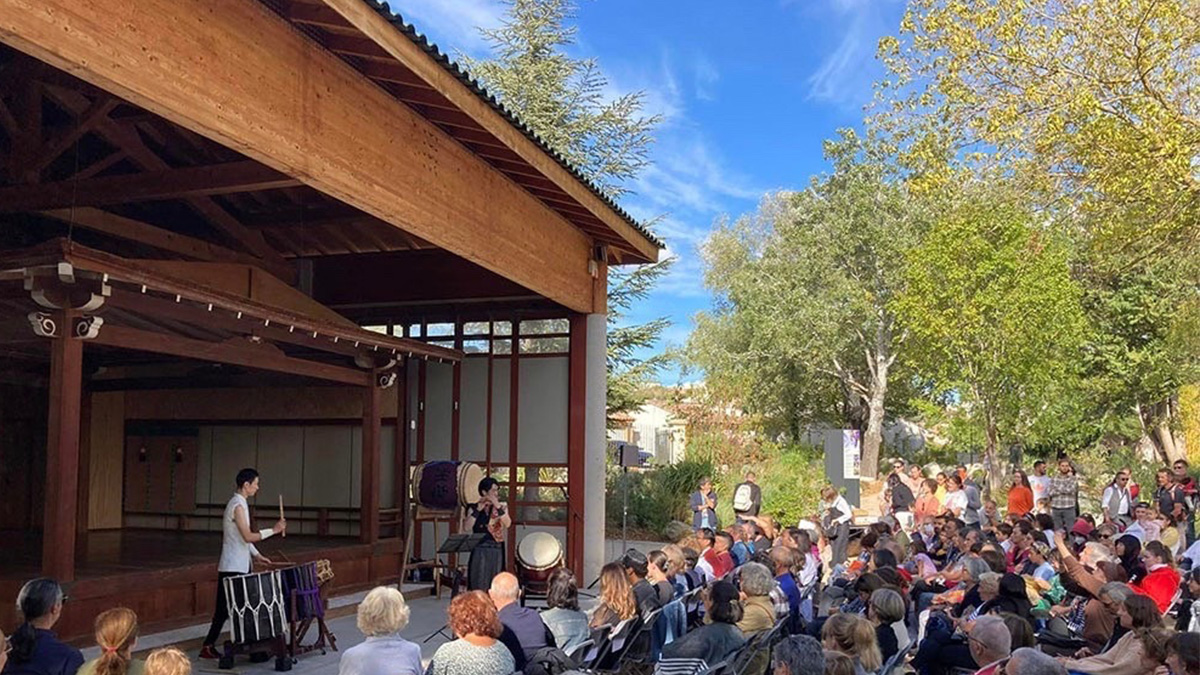
Appearing at events, holding workshops: with many performers on our roster, there is work that only we can do. The venues range widely too, from gymnasiums, theatres and classrooms to shopping centres and the open air. We send the performers best suited to the aim and the concept of each occasion we are asked to join.
Message
A Word From Our Founder
A message from our founder
In the traditional performing arts we make much use of the character michi — a path. From my birth until the present day, I have walked that path slowly.
There came a time when I began to catch glimpses, within the depths of this world, of things that were closed off, or that seemed to exist for self-satisfaction alone, and there were moments when I nearly lost my way. Yet a performer of these arts takes it as a duty to convey them to those who come to watch and to feel, and it is with that conviction that we devote ourselves to our study.
And when I looked around me, I found artists of real quality who shared the same aspiration and would walk the road with me. Asking ourselves whether there might be something we could do that would be of service to you, we have now come to open a path toward the future. We would be most grateful for your guidance and encouragement.
Shoko Toyama — Managing Partner
Glossary
Nine Words Worth Knowing
Nine words worth knowing
The minimum vocabulary for the arts we present. Knowing these nine words is enough to enjoy any of it.
Nihon Buyo
日本舞踊 / にほんぶよう
A dance form that developed from the dance sections of kabuki during the Edo period. Using a fan and kimono, it expresses narrative and emotion through the contrast between stillness and movement.
Sado
茶道 / さどう
The practice and philosophy of preparing and serving matcha for a guest. Every movement carries meaning, and the utensils and sweets are chosen to make that particular occasion unrepeatable.
Nagauta
長唄 / ながうた
A song form with shamisen that developed as accompaniment for kabuki. It is performed both as accompaniment to Nihon Buyo and as music in its own right.
Koto
箏 / こと
A 13-string Japanese zither. It is tuned by moving movable bridges and played with picks worn on the fingers, in repertoire ranging from classical to contemporary.
Shakuhachi
尺八 / しゃくはち
An end-blown bamboo flute with only five finger holes; pitch and timbre are shaped by breath and the angle of the head. It also has a history as an instrument of Zen practice.
Tate
殺陣 / たて
Choreographed swordplay for stage and screen. It is not combat but movement designed to be watched — every exchange is set in advance.
Shodo
書道 / しょどう
The art of writing with brush and ink. Because a stroke cannot be redone, expression comes from speed, dry-brush texture and the space left empty.
Taiko
和太鼓 / わだいこ
Japanese traditional drums. Long used in festivals and ritual, they were reorganised into an ensemble stage art during the twentieth century.
Mizuhiki
水引 / みずひき
A craft of tying cords made from twisted, stiffened washi paper. Best known as the decoration on ceremonial envelopes, each knot carries its own meaning.
Company
Company Profile
Contact
Start with the venue
and the time slot.
You do not need to have chosen a programme. Tell us the size of the room, how long you can give us, and who will be watching — we will propose the rest.