

DEN Tokyo
FAQFrequently asked questions
"It looks intimidating." "I don't know the etiquette." We answer those first.
No. Our programmes are designed for audiences who have never seen kabuki or noh. Before each piece we give a short introduction — the story, what to watch for, and what the gestures mean — so that first-time viewers can follow it as it happens.
Yes. Our artistic director, Naoyuri Wakayagi, introduces the pieces in English himself. Several of our artists have also performed and taught at Japan Expo in France, HyperJapan in the UK, and in Belgium, Taiwan, Korea, Germany, India and the United States, and lead workshops in English.
There is no dress code and no need to wear kimono — everyday clothes are fine. If sitting on the floor is difficult, chairs can be provided; please let us know when you book.
Between 20 and 60 minutes as a guide. We can build a 20-minute slot to sit inside a reception, or a 40–60 minute standalone programme, and we set the running order around your schedule. If time is tight, ten minutes is the shortest programme we can put together — please ask.
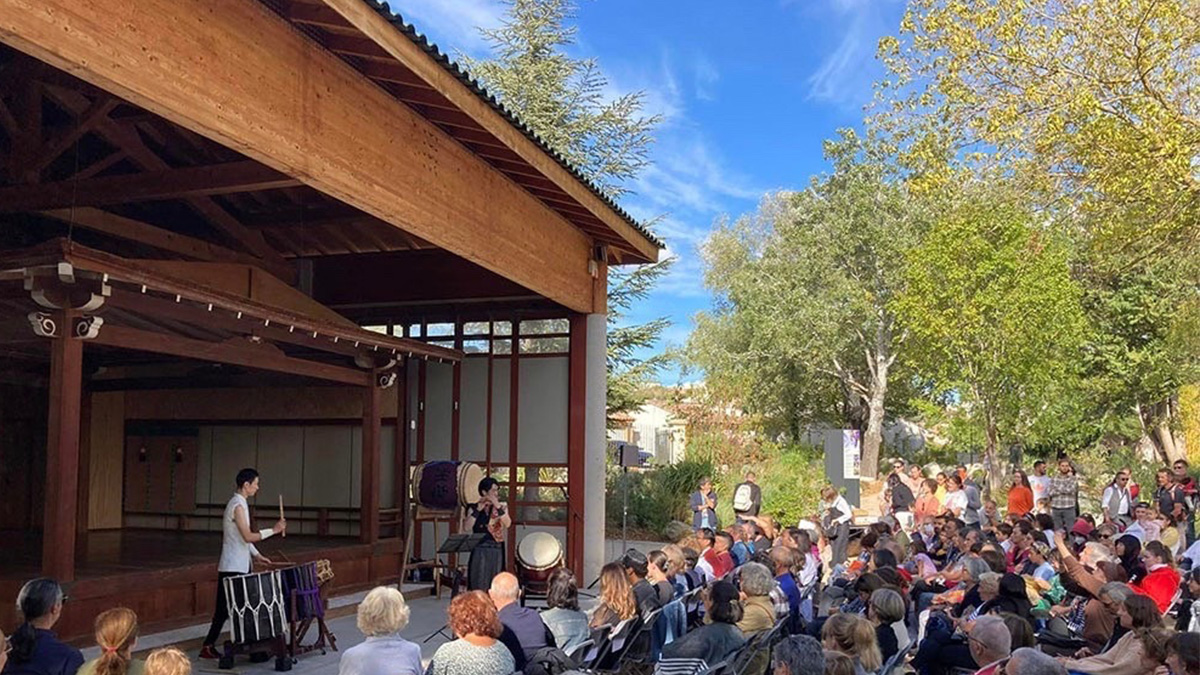
In theatres, and also in hotel and ryokan lobbies and banquet halls, event halls, restaurants, outdoor stages, schools and care homes. A stage is not required — we can perform anywhere with a suitable floor and ceiling height.
Our tea ceremony programme starts from ¥50,000, the DEN Iki dance programme from ¥50,000, and the flagship DEN Tokyo programme — full white makeup, authentic costume and wig — from ¥300,000. The final figure depends on the number of performers, running time, venue and travel, so we quote each booking individually.
Yes. Dance with live nagauta or koto, calligraphy with swordplay, a tea service alongside a dance piece — all of these can be combined. Tell us the total running time and the venue, and we will propose a structure.
Two weeks before the date at the latest. Rehearsal and the preparation of costumes and wigs both take time, and the more notice you can give us, the closer we can get to your ideal line-up. If your date is already close, please ask anyway.
As a rule, yes — for your own personal use. Some venues and some pieces carry restrictions, and we will tell you on the day if that applies. Commercial or broadcast use is arranged separately.
Yes. We regularly perform in primary, junior high and high schools, and several of our artists teach children's workshops and children's kabuki. We are happy to adapt a programme for a young audience.
Yes. We work both in Japan and abroad, and our artists have performed in France, the UK, Belgium, Italy, Taiwan, Korea, China, Singapore, Germany, India, the United States, Turkey, Vietnam and across Central America and Africa.
Nihon Buyo is a dance form that grew out of the dance sections of kabuki in the Edo period, roughly 400 years ago. Where kabuki is full theatre with dialogue and plot, Nihon Buyo presents the dance itself as an independent art. Noh is older still — a masked theatre form from the Muromachi period — with different conventions, music and movement. DEN Tokyo's core discipline is Nihon Buyo.
Still unsure?
Anything not covered here — just ask.
We reply in English or Japanese.
Contact
Start with the venue
and the time slot.
You do not need to have chosen a programme. Tell us the size of the room, how long you can give us, and who will be watching — we will propose the rest.